
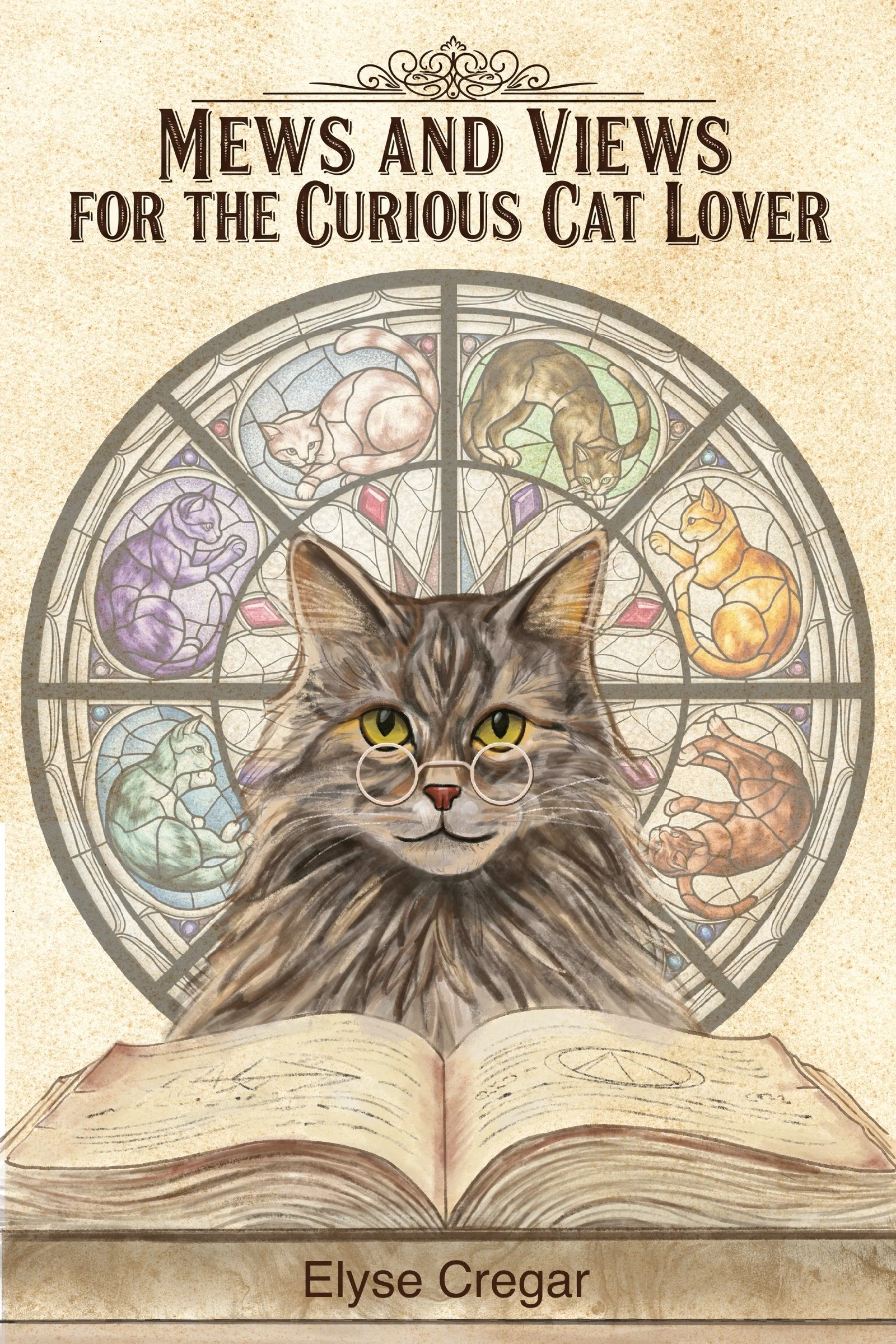
Chapter Excerpts from Mews and Views for the Curious Cat Lover
Splitting Hairs in Ancient Egypt:
Have your cats been showing signs of entitlement? Do they walk around you with their tails switching as if impatient? Do they stare at you with unblinking eyes while you are trying to sleep? Do they rub against your legs when you open the refrigerator? These may be signs of behavior cats have exhibited for centuries. These behaviors might even have been bred into them.
If your cat leaves you an occasional gift of a dead mouse, what are you expected to do with it? This is another inherited behavior. Cats have been ridding human dwellings of vermin for centuries and, yes, though not entirely selfless creatures, they do expect some gratitude: playtime, a gentle brush, a warm lap, perhaps a TV video for cats.
Your cats may carry the genes of the ancient Egyptian felines who were worshipped for thousands of years! This could explain our cats’ exalted behavior, also often displayed by human royalty.
Egyptians knew Bastet as the Cat Goddess of the Upper and Lower Nile River, who brought goodness to humans and protected hearth and home. As the daughter of Isis, who oversaw a wider spectrum of human welfare, Bastet was an easily accessible manifestation of the spirit world. Her sisters were most often known as Sekhmet and Wadjet.
Enter Sekhmet, the lioness-headed goddess. People also worshipped Sekhmet as Bastet’s powerful warrior sister, and they considered her a daughter of Isis. Carrying the solar disc upon her head, Sekhmet represented the dark side of humanity and of nature. The goddess of war and pestilence, Sekhmet emerged from the desert of the all-powerful Sun God Ra, who was both the destroyer and giver of life.
Bastet often appeared with a woman’s body and the head of a cat, holding an ankh, the symbol of life, and a sistrum, a mystical musical instrument. Kittens played at her feet. The Eye of Horus represented the cat’s extraordinary ability to see at night and to focus on the slightest movement. Mau, the Egyptian name for cat, translated, means “to see.”
What does your cat see as she surveys her realm?
Do Cats have Nine Lives? and Other Mysteries
Did early humans experience a sense that within the depth and darkness of caves both animals and humans might experience a spiritual connection? That life might continue beyond the death that must have surrounded these early humans?
Humans adopted and adapted cats and dogs to be an integral part of their societies. Perhaps painting a lion on a cave wall created a new kind of bond. If you study the eyes of a cat, you may see a mystery reflected into your own eyes. Were these moments of humans holding a flickering torch within a cave, possibly alone in this silent sanctuary, the moments when painting an animal led to something more present . . . or prescient? Were our creative ancestors able to go deep into another state of being? I do wonder about the origins of this deep connection.
The span of thousands of years is hard for me to grasp. But I can understand why early men and women saw meaning in their animal companions. Beyond a daily meal, beyond a warm fur wrap, beyond the rush of adrenalin at the sight of a lion, there must have been a moment when the four eyes met. A blink, a flicker of an eyelid, the low growl of a lion that evolved over centuries into the contended purring of a small cat.
As cats and dogs became entwined with humans over thousands of years we now marvel at the behaviors of our pets. But we may never understand the mystery of who lives behind those eyes. Do they reveal a soul?
Where did our friendly little pets come from? What do they know? And what did our ancestors know that we may have forgotten?

Cats in Line and Color: Feeling Creative?
Continuing with the feline theme in art, this chapter may spark a creative note in my readers who want to try their hand at drawing or painting.
First, let me get one thing out of the way. I cannot tell you how many times I have been painting plein air or hosting a show when I hear variations of the following words:
“I wish I could draw (paint, sculpt, learn an online art program, improve my photography, etc.) I’ve tried, but I just don’t know how to start (to make the time, to find the right paints and tools, to be happy with the process, to create a masterpiece.”)
I believe we all have a gremlin or two in our brains that tells us that if we don’t create a “masterpiece” in our first efforts, then why bother? No one creates a finished product at first unless it’s a five-year-old who found a crayon to apply to the stucco walls of her house. (That would be me.)
Another common and scary myth in circulation is, “Oh, the watercolor medium is so difficult! I don’t know how you (anyone, well-known artists, five-year-olds) paint with watercolor!”
Mix a bit of watercolor paint with water and watch it flow. Push it around with a brush (an old sponge, your finger, an old toothbrush, bits of nature from your backyard.) Magic happens. Dip your brush into the paint and let it dry. Add another color next to it. Or add two wet colors next to each other and watch them blend. Use a tissue to blot off color, and you have created a sense of clouds. As you gain confidence, you will want to purchase better grades of paint, paper and brushes. They DO make a difference!
In these difficult times, when our emotions and reason are tossed around like ships in a storm, when we may feel helpless against the storms roiling our familiar world, when we fear shipwreck, abandonment and intense loss of the familiar, art may become an antidote to despair. It may even lift you to a quiet shore. When you make art (visual, musical, literary, virtual, etc.), you create something new in your world and perhaps beyond. Art may even become both a soothing and challenging way to spend a few hours now and then. I highly recommend it.